
A $100M Settlement for Family of Man Killed in Grand Canyon Helicopter Crash
BY ROSS TODD

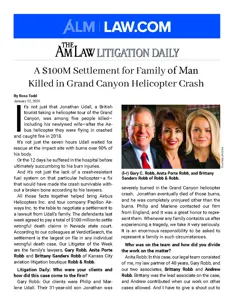
(l-r) Gary C. Robb, Anita Porte Robb, and Brittany Sanders Robb of Robb & Robb.
It’s not just that Jonathan Udall, a British tourist taking a helicopter tour of the Grand Canyon, was among five people killed— including his newlywed wife—after the Airbus helicopter they were flying in crashed and caught fire in 2018.
It’s not just the seven hours Udall waited for rescue at the impact site with burns over 90% of his body.
Or the 12 days he suffered in the hospital before ultimately succumbing to his burn injuries.
And it’s not just the lack of a crash-resistant fuel system on that particular helicopter—a fix that would have made the crash survivable without a broken bone according to his lawyers.
All those facts together helped bring Airbus Helicopters Inc. and tour company Papillon Airways Inc. to the table to negotiate a settlement to a lawsuit from Udall’s family. The defendants last week agreed to pay a total of $100 million to settle wrongful death claims in Nevada state court. According to our colleagues at VerdictSearch, the settlement is the largest on file in any individual wrongful death case. Our Litigator of the Week are the family’s helicopter crash lawyers, Gary Robb, Anita Porte Robb and Brittany Sanders Robb of Kansas City aviation litigation boutique Robb & Robb.
Litigation Daily: Who were your clients and how did this case come to the firm?
Gary Robb: Our clients were Philip and Marlene Udall. Their 31-year-old son Jonathan was severely burned in the Grand Canyon helicopter crash. Jonathan eventually died of those burns, and he was completely uninjured other than the burns. Philip and Marlene contacted our firm from England, and it was a great honor to represent them. Whenever any family contacts us after experiencing a tragedy, we take it very seriously. It is an enormous responsibility to be asked to represent a family in such circumstances.
Who was on the team and how did you divide the work on the matter?
Anita Robb: In this case, our legal team consisted of me, my law partner of 40 years, Gary Robb, and our two associates, Brittany Robb and Andrew Robb. Brittany was the lead associate on the case, and Andrew contributed when our work on other cases allowed. And I have to give a shout out to our extraordinary staff, headed up by our dedicated senior paralegal of 21 years, Jacie Anello.
Gary and Brittany headed up the initial jurisdictional challenge in the case. Andrew and I next tackled the preemption and choice of law challenges raised by the Airbus Helicopters defendants. Gary and Brittany took the liability depositions, while I focused on the damages aspects along with help from Brittany.
We feel fortunate that our team is flexible and experienced in all aspects so we can pitch in and help where needed and also keep pressing on our other cases.
What does a crash-resistant fuel system look like? And why wasn’t there one on this helicopter?
Gary Robb: As opposed to the old-style plastic or milk jug-style fuel tank that was on this helicopter, a crash-resistant fuel system (CRFS) is designed to contain fuel in the event of a crash. The prototype consists of an aluminum shell within which is contained a flexible rubber bladder. Also included are breakaway rods and shafts to prevent penetration into the fuel tank.
There is no good reason why a CRFS was not installed on the subject helicopter. It has been well-known in the industry and readily available since the 1970s.
Airbus Helicopters attempted to remove this case to federal court. The case went up to the Ninth Circuit on an issue of first impression on that front. Can you briefly outline what went on there and how your client came out on top on that question?
Brittany Robb: Airbus Helicopters removed the case to federal district court, asserting Sec. 1442(a)(1) as the basis for removal. That provision permits removal of any action against “any officer (or any person acting under that officer) of the United States or any agency thereof, in an official or individual capacity, for or relating to any act under color of such office.” The district court granted plaintiffs’ motion to remand, citing to a Seventh Circuit decision that activities of Boeing “pursuant to its [Federal Aviation Administration] delegation are rule compliance rather than rule making.”
Airbus Helicopters then appealed to the Ninth Circuit on the issue of whether they satisfied the “acting under” prong of Sec. 1442(a)(1). In its opinion affirming the district court’s remand, the Ninth Circuit opinion by Judge Rawlinson noted that at oral argument, Airbus Helicopters had conceded and “even acknowledged that the FAA has the authority to rescind any action taken by AHI in connection with the certification process…. thus falling within the ‘simple compliance with the law’ circumstance that does not meet the ‘acting under’ standard.”
The Ninth Circuit concluded by joining the Seventh Circuit in holding that an aircraft manufacturer does not act under a federal officer when it exercises designated authority to certify compliance with governing federal regulations. “AHI’s mere compliance with federal regulations did not satisfy the ‘acting under’ requirement of Sec. 1442(a)(1).” Airbus Helicopters then petitioned the Supreme Court to grant a writ of certiorari. That request was denied, and the case was remanded.
This matter settled on the second day of hearings on motions in limine. What do you think ultimately motivated the defendants to come to the table?
Anita Robb: The defendants in our cases never tell us what motivates them to come to the table. We just did the same thing in this case that we do in every case—which is to prepare for trial as best we can every day and in every way.
My colleagues at VerdictSearch tell me there is no settlement higher than $100 million in their database for the wrongful death of a sole decedent. I don’t want to be insensitive to Mr. Udall’s suffering, but what got this case to that number?
Brittany Robb: No amount of money will ever bring Jonathan back. This amount, in part, speaks to Jonathan’s unimaginable and immeasurable suffering. Jonathan suffered in agonizing pain for seven hours as he was stranded in the Grand Canyon. When he finally got to the hospital, he continued to suffer excruciating pain, consciously, for 12 days as he fought for his life. The testimony regarding Jonathan’s suffering was powerful.
The strength and determination of Philip and Marlene Udall is also reflected in this amount. This case was never about the money for Philip and Marlene Udall. Their goal has been to create change in the industry so other families do not have to suffer as they have suffered and as their son suffered. With this record settlement and no confidentiality–which they steadfastly demanded—they will be able to speak out about this preventable tragedy and work towards the change they so desperately want to see in this industry.
Now, instead of having Jonathan’s name tied solely to this tragic crash, his name will be forever tied to his parents’ years-long fight to make this industry safer.
Your clients insisted that this settlement be public. Why?
Gary Robb: Because they wanted to shine a spotlight on this critical public health menace and save other victims and their families from going through what they and their son went through. Mr. Udall would have survived without any injury if the helicopter had been properly equipped with a crash-resistant fuel system. That technology has been available since the 1960s, and is virtually 100% effective. But Airbus Helicopters has resisted utilizing it and has taken advantage of a regulatory loophole to avoid the safety requirement.
What message do you hope others in the industry take from this settlement?
Anita Robb: It is a moral imperative. If the aviation industry will just always put safety first and think about the well-being of their customers, both the industry and consumers will come out ahead in the end. This is now the second $100 million settlement that our law firm has obtained for post-crash burn injuries in Airbus helicopters without CRFS. We think it is time that Airbus Helicopters and the industry realize and admit that it is economically logical to pay for and install critical known safety features such as CRFS on the front end, rather than paying damages for burning people alive after the fact.
What will you remember most about this matter?
Anita Robb: What I will remember forever is the testimony of three witnesses—Jonathan Udall’s burn surgeon, and two members of the Australian Air Force who rendered assistance to him at the scene.
The burn surgeon, who has treated thousands of burn patients, detailed the excruciating nature of Mr. Udall’s severe burns and his suffering— and testified that unlike many burn victims, he fought to live until the very end. The Australians, who were in the Grand Canyon on another sightseeing flight, described Mr. Udall’s simultaneous agony and courtesy while he was stranded with 90 percent body burns in the ravine overnight for 7 hours fully conscious—in the cold and without available medical supplies.
Brittany Robb: I will never forget the courage and strength of our clients, Philip and Marlene Udall, as well as their daughter, Sarah. In the face of this unspeakable tragedy, they persevered and never gave up on their quest for justice for Jonathan by exposing the utterly preventable nature of his death. Through all the procedural hurdles and a global pandemic, they remained steadfast in their quest for answers and accountability. Over the past six years, we feel as if we have also gotten to know who Jonathan was—a truly remarkable and dedicated son, brother, friend, and colleague. Representing the Udall family on behalf of Jonathan is an honor, and has reaffirmed why I became a plaintiffs’ attorney.
Gary Robb: The steadfast strength and courage of our wonderful clients in fighting through this journey to justice.